8 Best Ground Covers to Replace Grass in Bengaluru Landscapes & Gardens
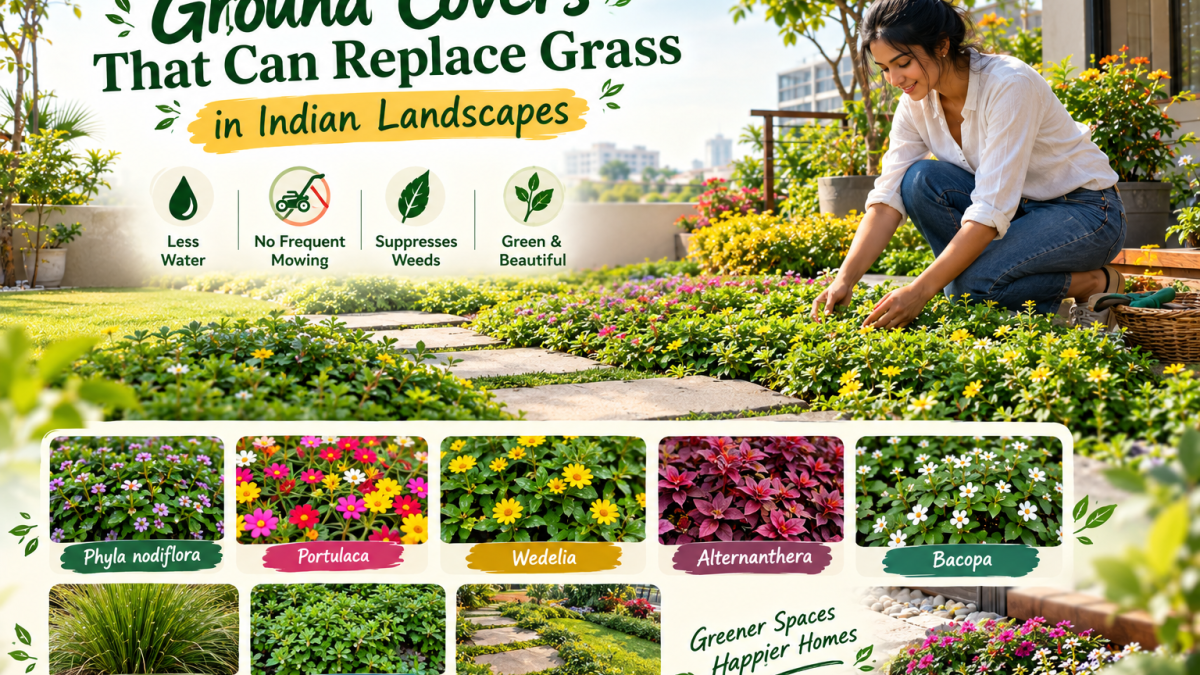
A lush, emerald-green lawn has long been considered the crowning jewel of landscape architecture. However, maintaining a conventional turfgrass lawn in Bengaluru has rapidly evolved from a rewarding gardening routine into an uphill, unsustainable battle. Between severe Cauvery water rationing, depleting borewells in peripheral neighborhoods like Whitefield, Sarjapur, and Devanahalli, skyrocketing private water tanker bills, and scorching pre-monsoon heatwaves, traditional Bermuda or Korean lawns demand vast volumes of potable water, noisy weekly mowing, expensive chemical fertilizers, and relentless weeding.
Fortunately, innovative sustainable landscape designers and eco-conscious homeowners across Karnataka are turning to ground covers. Ground-covering perennials spread horizontally along the soil surface via creeping runners, stolons, or dense rhizomatous clumps. They create an uninterrupted living carpet that locks moisture into Bengaluru’s sandy red loam, suppresses aggressive weeds, cuts maintenance down to virtually zero, and adds stunning multidimensional textures and vibrant blossoms that conventional grass simply cannot offer.
Why Replace Traditional Grass Lawns in Bengaluru Gardens?
Traditional monoculture turfgrasses—such as Bermuda grass (Cynodon dactylon), Korean grass (Zoysia japonica), or St. Augustine—are among the thirstiest plants in ornamental horticulture. During peak summer months (March through May), a modest 500-square-foot turf lawn in Bengaluru easily guzzles 350 to 500 liters of water daily just to stave off yellowing and root burn. With BWSSB restrictions and municipal crackdowns on hosepipe garden irrigation, keeping manicured turf is neither ecologically ethical nor financially practical.
Switching to well-adapted, native, and climate-resilient ground covers provides transformative ecological and practical advantages:
• Zero or Minimal Mowing: Forget noisy, petrol-guzzling mowers and weed-whackers on Sunday mornings. Most ground covers stay naturally low (under 5 to 15 cm) without ever requiring trimming.
• Up to 70% Less Water Consumption: Once established, drought-tolerant species survive easily on minimal drip irrigation or once-weekly deep soaking, remaining lush even during extended dry spells.
• Natural Soil Cooling & Weed Suppression: A dense living mulch shades Bengaluru's red clay-loam, preventing moisture evaporation, moderating rhizosphere root temperatures, and blocking weed seed germination.
• Vibrant Biodiversity & Pollinator Haven: Instead of an artificial chemical-laden green desert, flowering ground covers welcome beneficial honeybees, native butterflies, and essential micro-fauna back into urban gardens.
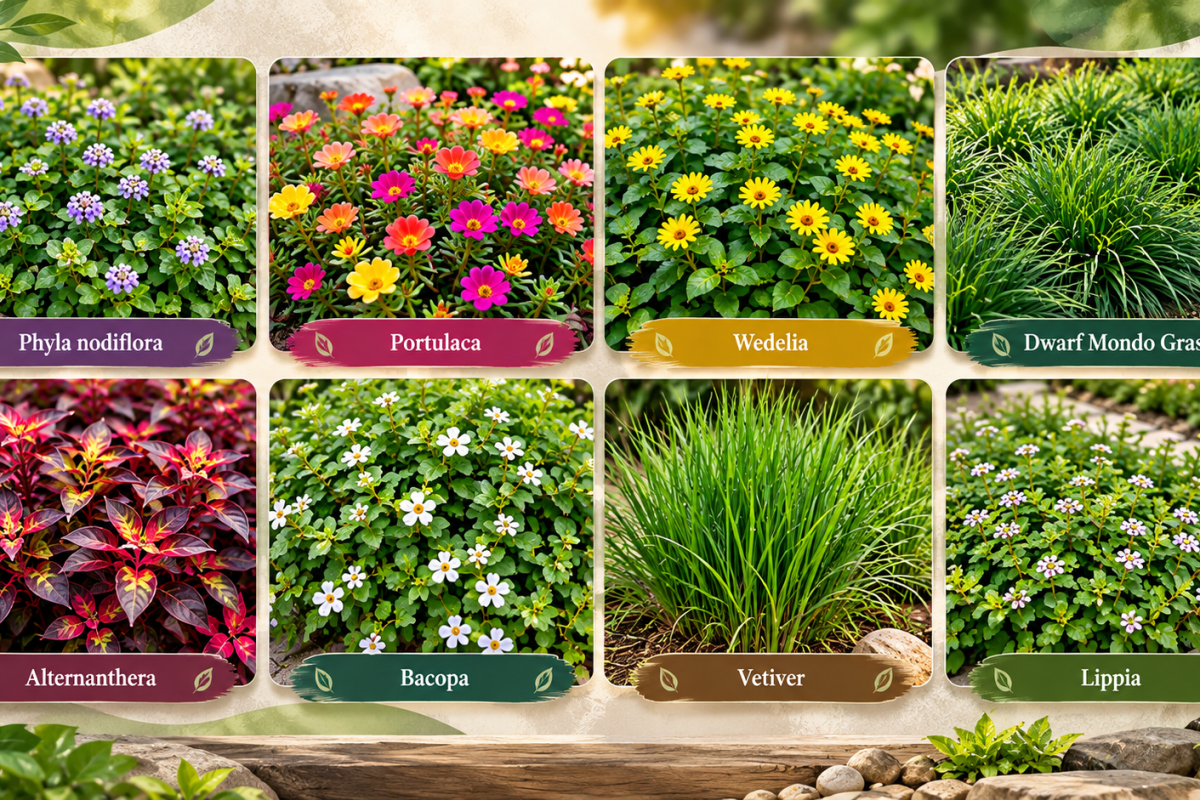
Below, we profile the 8 best ground covers proven to thrive across Bengaluru’s unique elevation (920 meters above sea level), semi-arid climate, and varied landscape topologies.
1. Phyla nodiflora (Frogfruit) – The Ultimate Walkable Native Green Carpet
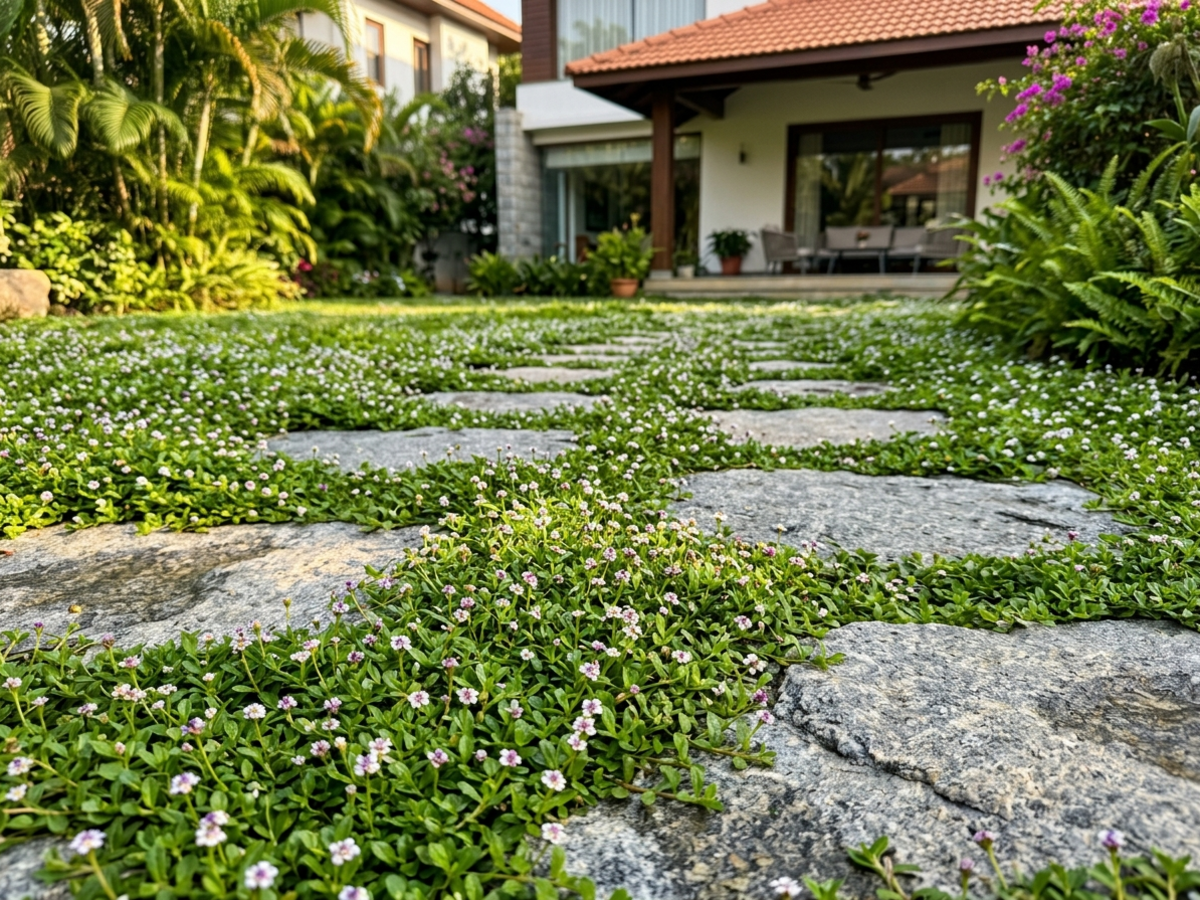
Botanical Name: Phyla nodiflora (syn. Lippia nodiflora) | Common Names: Frogfruit, Turkey Tangle Fogfruit, Poduthalai (Tamil), Jalapippali (Sanskrit)
If your primary goal is finding an authentic direct replacement for conventional turfgrass that accepts moderate foot traffic, children's play, and pets, Phyla nodiflora is the undisputed gold standard. Native to the Indian subcontinent, this perennial creeping herb forms a dense, hugging green mat that rarely exceeds 5 to 8 cm in height. It spreads rapidly through prostrate nodes that root directly wherever they touch bare soil.
From early spring through late autumn, Frogfruit produces profuse, miniature white-and-purple clover-like flower heads that attract pollinating native bees and butterflies. It performs exceptionally well in Bengaluru's nutrient-lean red soil, thrives under relentless full sun, and can survive weeks without supplemental irrigation once rooted. Furthermore, Phyla nodiflora leaves are naturally soft underfoot, making it the perfect lawn alternative for villa front yards, informal open spaces, and pathway seams.
• Sunlight: Full sun to light partial shade.
• Water Requirement: Extremely low; water deeply once every 7 to 10 days during dry spells.
• Foot Traffic Tolerance: Moderate to high (recovers rapidly from trampling).
2. Portulaca grandiflora (Moss Rose / Table Rose) – Vibrant Color for Sun-Baked Spaces
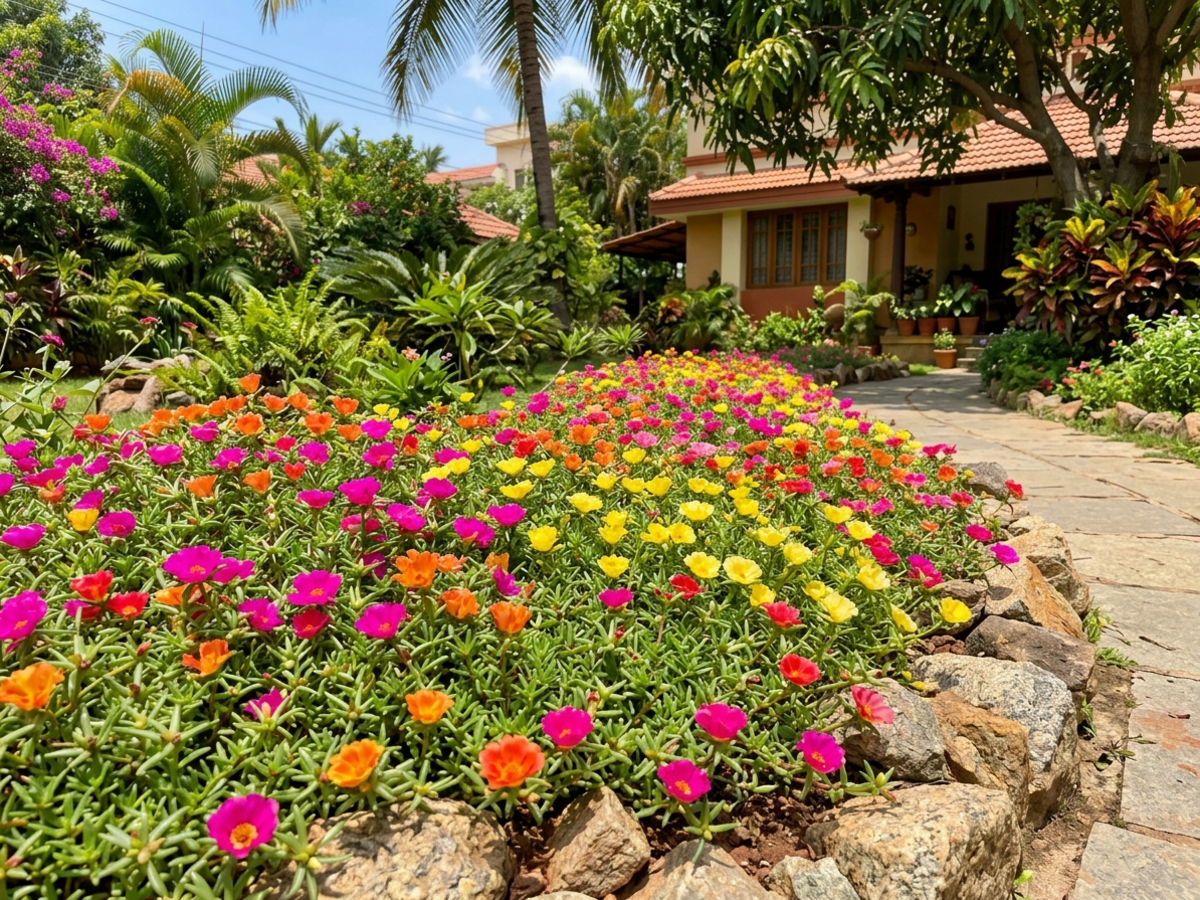
Botanical Name: Portulaca grandiflora | Common Names: Moss Rose, Table Rose, Office Flower, 10 O'Clock Flower
For exposed rooftop terraces, open south-facing courtyards, and rocky landscape embankments in Bengaluru that receive blistering all-day sun, conventional turf simply scorches and turns into brown straw. Portulaca grandiflora provides the exact opposite effect: it thrives on intense heat and rewards you with an explosion of brilliant pink, magenta, scarlet, golden yellow, peach, and crisp white blossoms.
Featuring semi-succulent, needle-shaped cylindrical leaves, Portulaca stores moisture within its fleshy tissues, enabling it to withstand prolonged drought and dry, gritty soil. While it does not tolerate heavy foot traffic, it is the premier ornamental ground cover for terrace garden beds, rockeries, roadside berms, and decorative borders along paved walkways. You can establish large sweeps quickly from cuttings.
Explore premium multi-colored Portulaca varieties for your garden: browse our curated collection of
Portulaca 4 Varieties Cuttings (Double Pink, Single Pink, Yellow, Orange)
• Sunlight: Unfiltered, full sun (minimum 5 to 6 hours for blooms to open fully).
• Water Requirement: Very low; allow topsoil to dry completely between waterings.
• Foot Traffic Tolerance: Low (ornamental display & border cover).
3. Sphagneticola trilobata (Wedelia) – The Rapid-Spreading Living Blanket
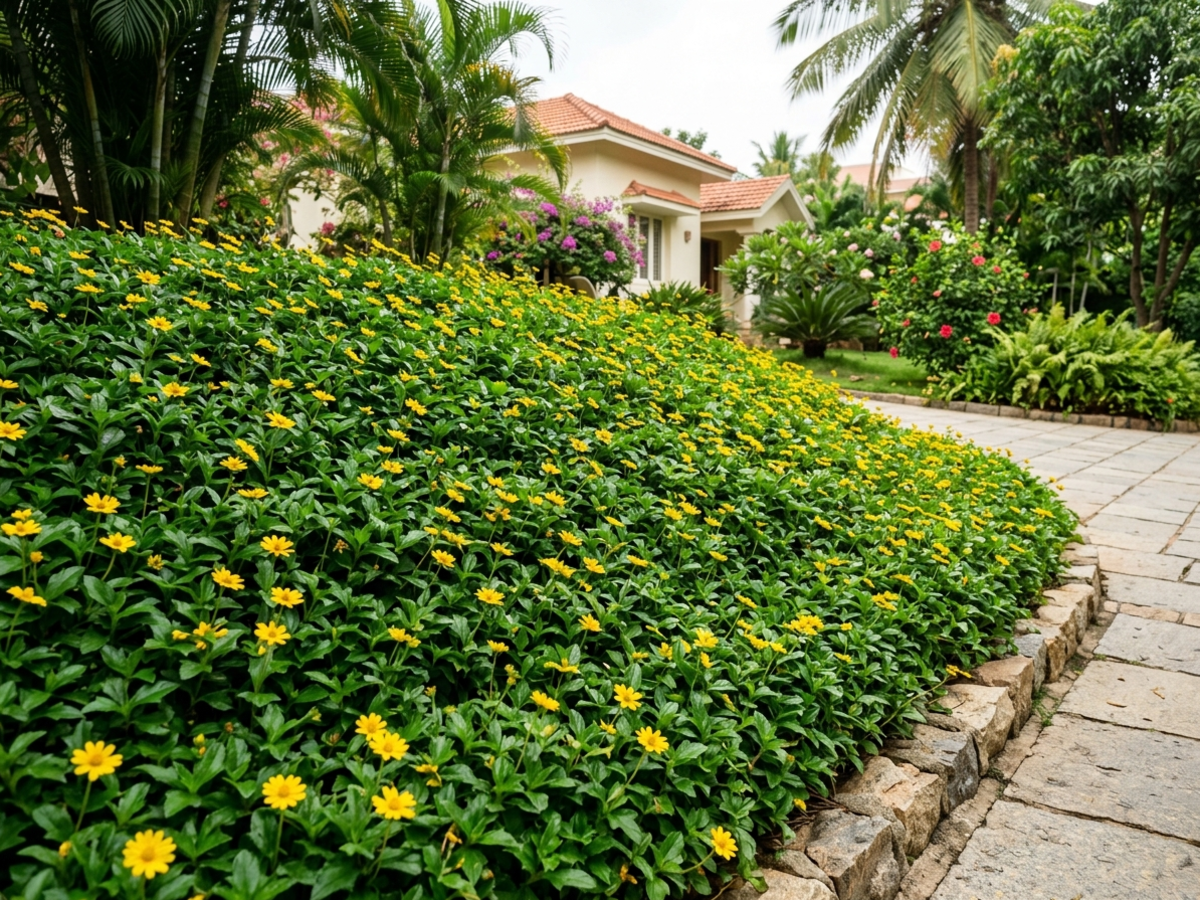
Botanical Name: Sphagneticola trilobata (formerly Wedelia trilobata) | Common Names: Creeping Oxeye, Yellow Creeping Daisy, Wedelia
When you have a massive open expanse of bare red soil, an awkward sloped embankment, or a large commercial compound in Bengaluru that needs complete vegetative coverage in under 60 days, Wedelia is the undisputed champion. This robust, trailing perennial produces lush, deep emerald-green serrated leaves topped continuously with bright, cheery yellow daisy-like flowers.
Wedelia creates such an impenetrable, dense foliage mat (15 to 25 cm high) that weeds cannot penetrate it. Its extensive network of stolons binds loose red soil together, eliminating rain-driven mudslides during Bengaluru's torrential monsoon cloudbursts. While its vigorous spreading habit means it should be edged away from delicate flowerbeds with concrete curbs or steel edging, it is unmatched for expansive villa perimeters, berms, and utility spaces.
• Sunlight: Full sun to medium shade.
• Water Requirement: Low to moderate; exceptionally resilient once rooted.
• Foot Traffic Tolerance: Low to moderate (best for slopes and mass plantings).
4. Ophiopogon japonicus 'Nana' (Dwarf Mondo Grass) – Luxury Architectural Turf for Shaded Courtyards
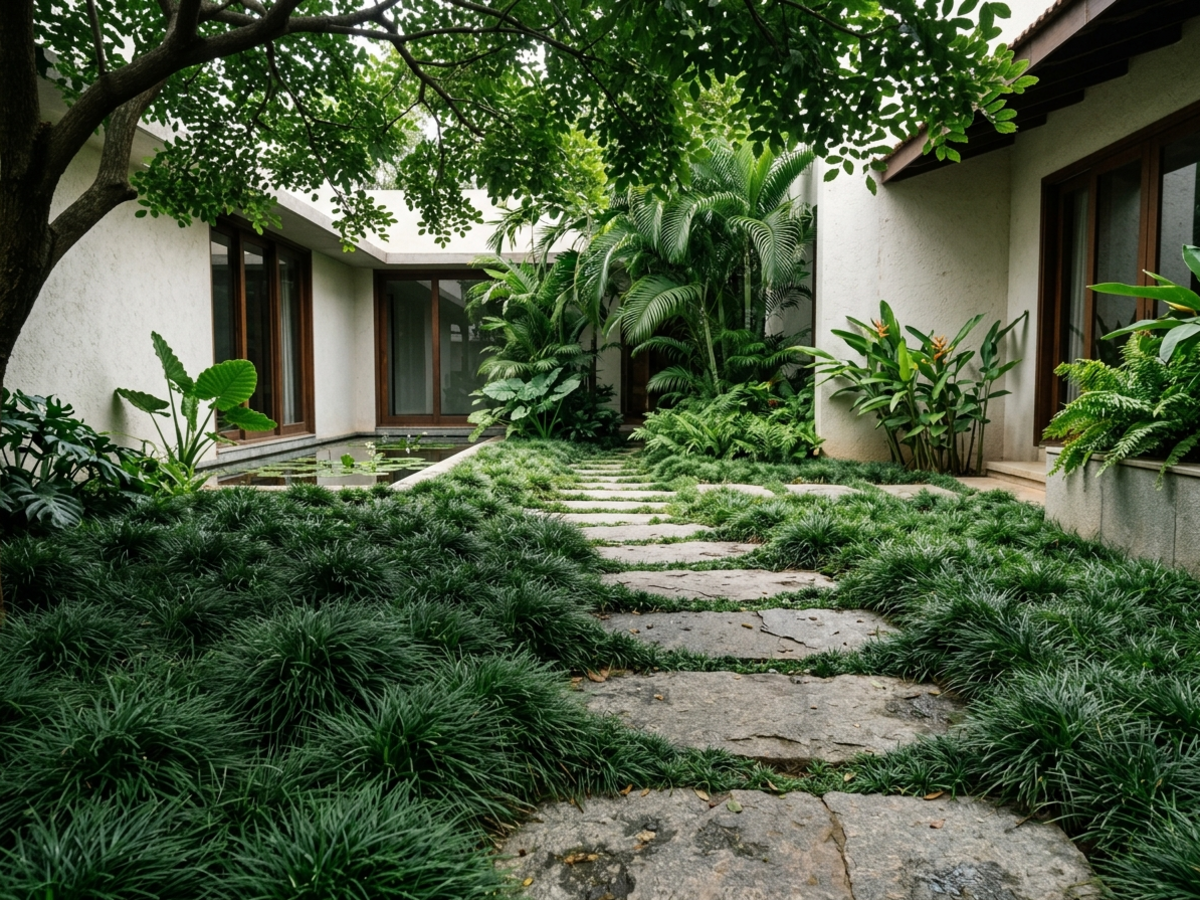
Botanical Name: Ophiopogon japonicus 'Nana' | Common Names: Dwarf Mondo Grass, Dwarf Lilyturf, Monkey Grass
One of the most persistent frustrations for Bengaluru homeowners is attempting to grow turfgrass under the heavy shade of mature Jacaranda, Rain Trees, Gulmohars, or inside narrow courtyard villas. Standard lawn grasses inevitably thin out, turn pale yellow, and rot away in shade. Dwarf Mondo Grass is the definitive luxury solution.
Technically an evergreen perennial member of the Asparagaceae family rather than a true grass, Dwarf Mondo produces ultra-compact, arching, dark forest-green strap-like blades that reach only 5 to 10 cm in height. It forms velvety, uniform cushions that never require mowing. It brings a sophisticated Japanese Zen aesthetic or contemporary minimalist luxury feel around stepping stones, water bodies, and shaded tree skirts.
• Sunlight: Partial shade, dappled light, or deep shade (avoid harsh afternoon sun).
• Water Requirement: Moderate; likes evenly moist, well-draining organic soil.
• Foot Traffic Tolerance: Light foot traffic; ideal around stepping stones.
5. Alternanthera dentata & ficoidea – Designer Color Contrasts & Geometric Beds
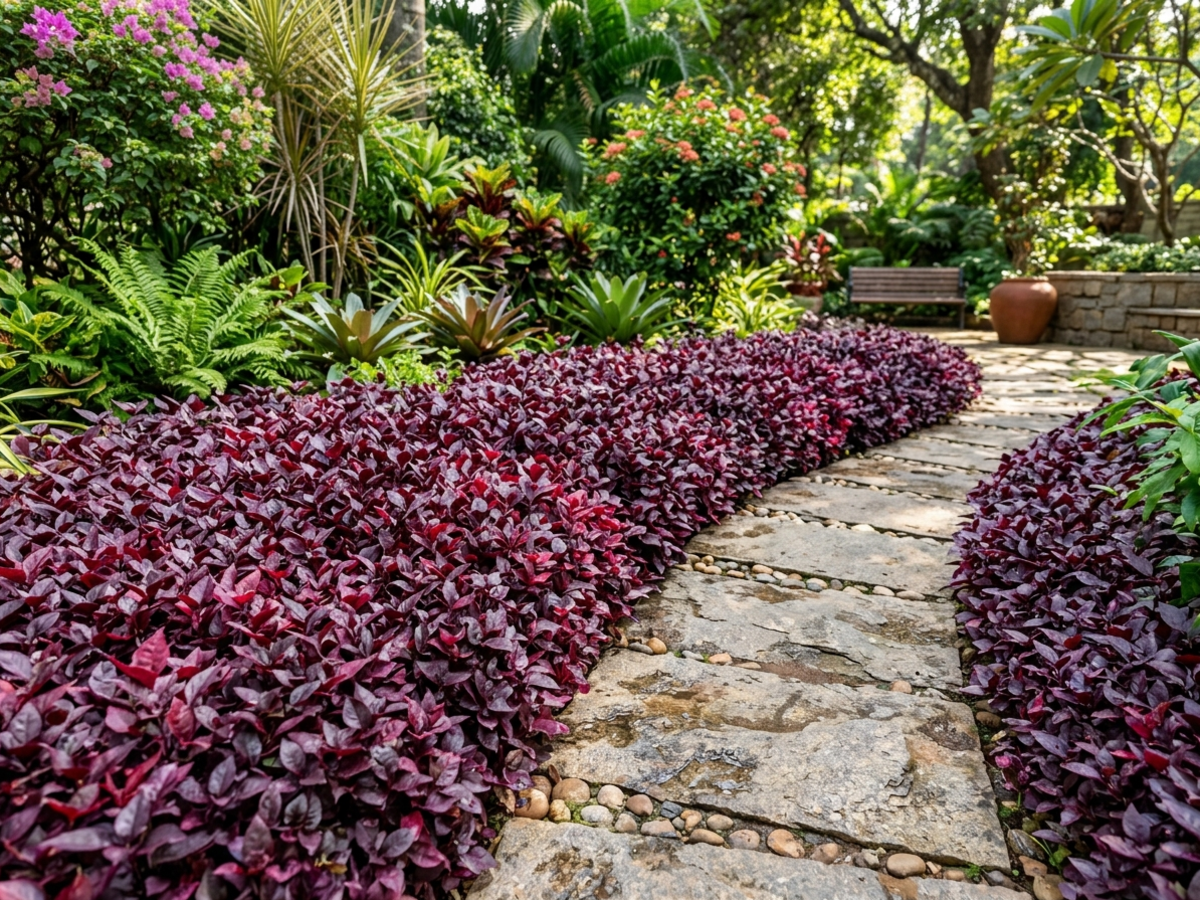
Botanical Name: Alternanthera dentata / Alternanthera ficoidea | Common Names: Joseph's Coat, Red Calico Plant, Ruby Alternanthera
Who said a ground cover lawn has to be green? In contemporary landscape design, rich crimson, ruby-red, and burgundy tones create breathtaking dramatic contrast when set against stone pavers, white gravel, or surrounding green foliage. Alternanthera is renowned across Indian royal gardens and high-end modern villas for its ability to deliver rich, uniform chromatic carpeting.
With its compact branching habit and metallic wine-red leaves that intensify in full Bengaluru sunlight, Alternanthera is exceptionally versatile. It can be left to sprawl as a plush 10–15 cm high ground cover or trimmed periodically to form clean geometric ribbons, borders, and lawn parterres. It is heat-hardy, pest-resistant, and propagates effortlessly from stem cuttings.
Bring rich burgundy tones to your landscape: order healthy nursery plants directly from
Alternanthera Dentata Potted Plants
• Sunlight: Full sun to bright dappled shade (full sun yields deep burgundy foliage).
• Water Requirement: Moderate; water when the top 2 inches of red soil feel dry.
• Foot Traffic Tolerance: Low (used as ornamental ground carpet and bed borders).
6. Bacopa monnieri (Brahmi) – Moisture-Loving Carpet for Swales, Ponds & Rain Gardens
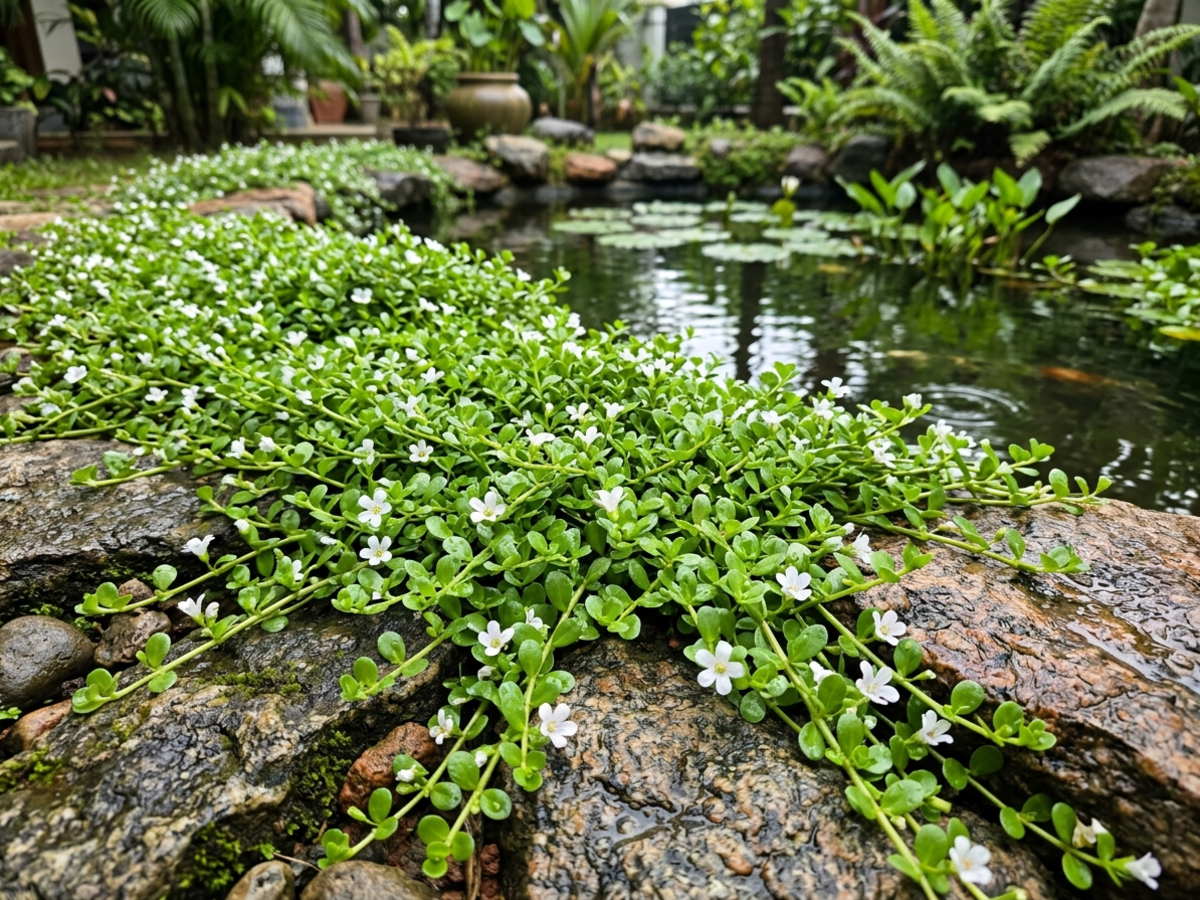
Botanical Name: Bacopa monnieri | Common Names: Brahmi, Water Hyssop, Herb of Grace
While drought-tolerant plants are vital for dry zones, almost every Bengaluru landscape has tricky damp spots: AC condensate drainage zones, low-lying garden swales where monsoon rainwater pools, the perimeter of koi ponds, water fountains, or garden tap runoffs. In these persistently damp zones, traditional turfgrass roots easily rot and drown. Bacopa monnieri thrives in precisely these conditions.
Revered in traditional Ayurveda as a premier brain-boosting herb, Brahmi is equally exceptional as an ornamental ground cover. It boasts succulent, rounded emerald leaves along creeping horizontal stems that root at every node, forming a tight, 5 to 10 cm high mat punctuated by dainty, pale lavender-white star-like flowers. It naturally filters runoff water, prevents soil erosion around water bodies, and adds a lush, refreshing coolness to humid garden pockets.
• Sunlight: Full sun to bright partial shade.
• Water Requirement: High to moderate; thrives in consistently moist or marshy soil.
• Foot Traffic Tolerance: Light foot traffic.
7. Chrysopogon zizanioides (Vetiver Grass) – The Ultimate Bio-Engineering Shield for Slopes & Retaining Walls
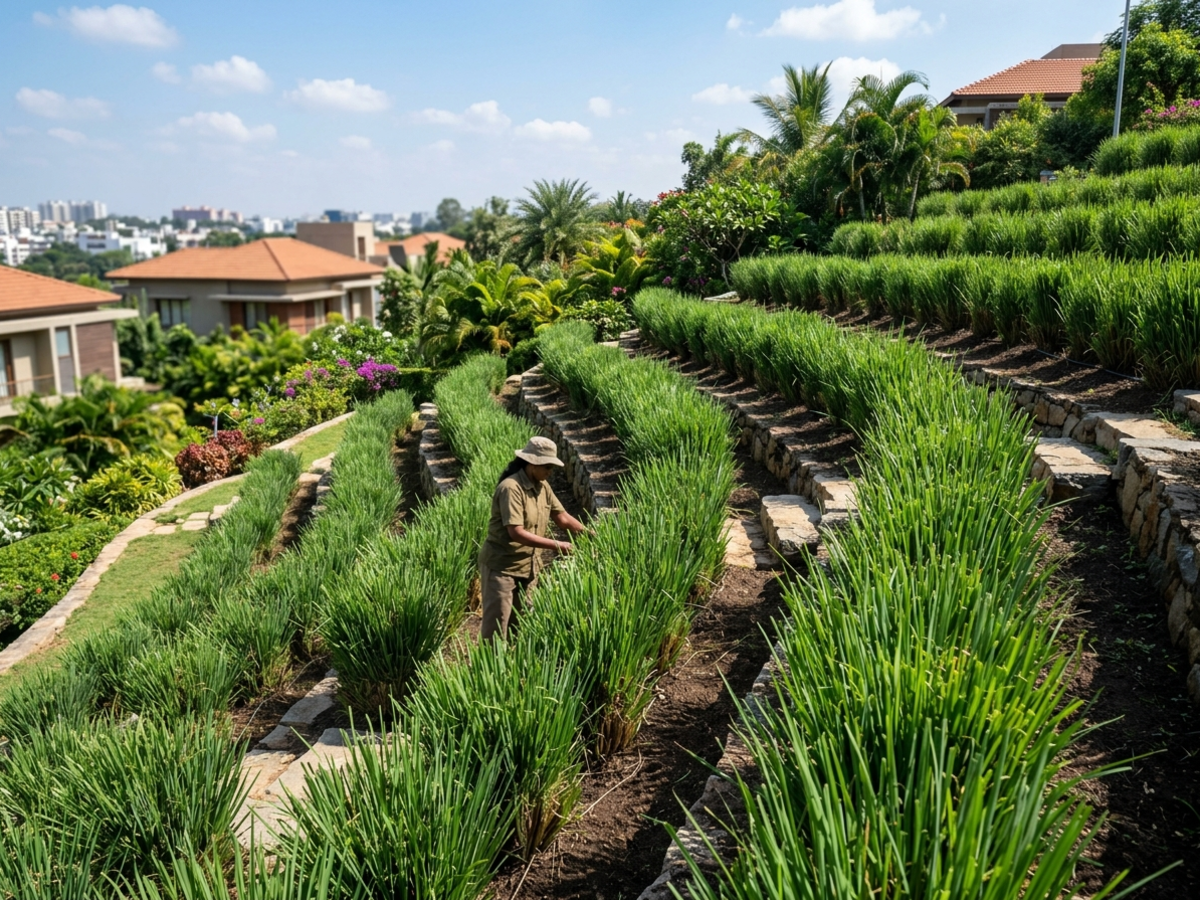
Botanical Name: Chrysopogon zizanioides | Common Names: Vetiver, Khus Grass, Miracle Grass
Unlike dwarf ground covers meant for open lawns, Vetiver serves an indispensable engineering purpose in Bengaluru’s undulating geography. If your property is situated on a steep slope, an excavated boundary wall, a tiered terrace garden, or an eroding stormwater runoff drain in hillside localities, standard grass turf simply washes away with topsoil during heavy downpours.
Vetiver is a miracle perennial bunchgrass famous worldwide for its colossal, vertical root architecture. Unlike turf grasses whose roots penetrate a mere 5 to 10 cm, Vetiver roots plunge 3 to 4 meters straight down like living steel rebars, interlocking the earth and stabilizing soil against landslides. Planted tightly in contour rows, Vetiver forms a dense vegetative barrier that filters sediment, recharges underground aquifers, and repels termites with its aromatic essential oils.
• Sunlight: Full, blazing sun.
• Water Requirement: Extremely low once rooted; virtually indestructible.
• Function: Slope stabilization, erosion defense, boundary windbreak, and aromatic living hedge.
8. Phyla canescens / Lippia repens (Creeping Lippia) – The Low-Profile, Drought-Hardy Turf Substitute
Botanical Name: Phyla canescens (syn. Lippia repens / Lippia canescens) | Common Names: Creeping Lippia, Kurapia alternative, Carpet Grass
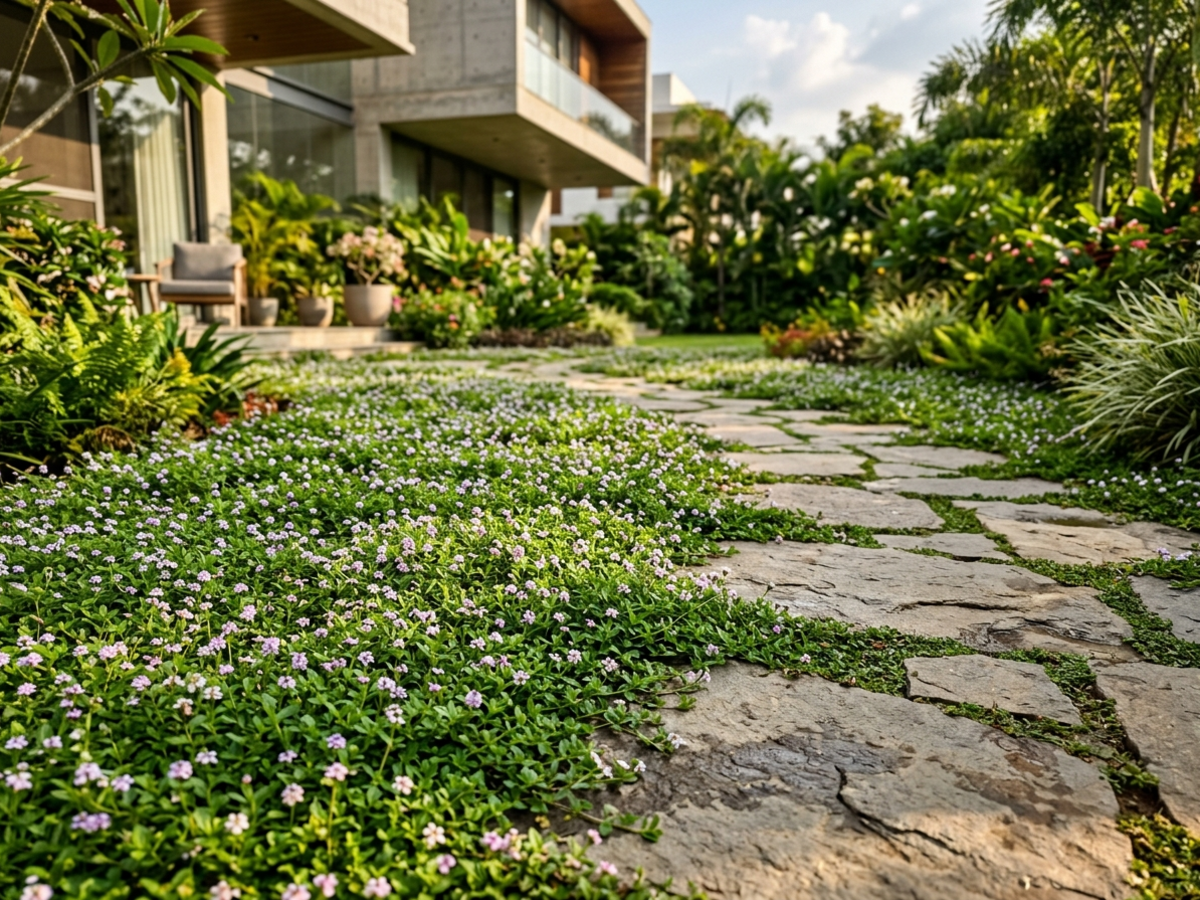
Creeping Lippia is one of the most celebrated sustainable lawn substitutes in modern ecological landscape design. Characterized by tiny, grey-green serrated leaves that stay exceptionally close to the ground (typically 2 to 5 cm high), Lippia knits an ultra-dense, walkable carpet that outcompetes troublesome weeds such as nutgrass and crabgrass.
In Bengaluru's pleasant, sunny weather, Creeping Lippia stays verdant throughout the year with only a fraction of the water demanded by Bermuda grass. It tolerates light-to-moderate foot traffic, handles occasional pet activity, and stays naturally dwarf so you never need to purchase or maintain a lawnmower. It also serves as an outstanding filler between large Kadapa stone or granite pavers, softening hard lines with natural greenery.
• Sunlight: Full sun to light dappled shade.
• Water Requirement: Low; highly drought-resilient once root network is established.
• Foot Traffic Tolerance: Moderate (ideal between stepping stones and garden pathways).
Smart Landscape Design: Combining Ground Covers with Stepping Stones & Pathways
One of the most effective principles in contemporary Bengaluru landscape architecture is the 'Hybrid Living Pathway' model. Rather than trying to force a fragile monoculture grass lawn across high-traffic foot zones, smart designers combine natural stone pavers with resilient ground covers:
1. Natural Stone Stepping Pavers: Install large natural stone slabs—such as rustic Sadarahalli grey granite, black Kadapa stone, or warm Kota limestone—spaced roughly 60 to 65 cm from center to center (the natural human walking stride).
2. Joint Fillers with Dwarf Creepers: Plant Phyla nodiflora, Creeping Lippia, or Dwarf Mondo Grass within the 3-to-4-inch joints and borders between the stone slabs. The pavers absorb the direct abrasive impact of daily footsteps, while the ground covers cushion the edges and maintain a vibrant green presence.
3. Pebble and River Boulder Accents: Use smooth river pebbles, gravel mulch, or volcanic basalt chips along borders to reduce weeding, direct rainwater infiltration into the subsoil, and create striking Zen garden textures.
Ground Covers Comparison Table for Bengaluru Landscapes
Use this quick reference guide to select the ideal grass replacement based on your garden's sunlight, foot traffic, and water conditions:
| Plant Name | Botanical Name | Sunlight | Water Need | Foot Traffic | Best Use in Bengaluru | |---|---|---|---|---|---| | Frogfruit | Phyla nodiflora | Full sun / Part shade | Very Low | Moderate to High | Direct lawn replacement, pathways | | Table Rose | Portulaca grandiflora | Full sun | Very Low | None (Ornamental) | Terraces, rockeries, sunny borders | | Wedelia | Sphagneticola trilobata | Full sun to shade | Low | Low | Slopes, large open plots, erosion control | | Dwarf Mondo Grass | Ophiopogon japonicus 'Nana' | Partial to Deep Shade | Moderate | Light | Shaded tree skirts, Zen gardens, courtyards | | Joseph's Coat | Alternanthera dentata | Full sun to part shade | Moderate | None (Foliage) | Crimson borders, geometric beds | | Brahmi | Bacopa monnieri | Full sun to part shade | High (Moist) | Light | Pond edges, drainage swales, rain gardens | | Vetiver Grass | Chrysopogon zizanioides | Full sun | Very Low | Heavy Rooting | Slopes, retaining walls, soil stabilization | | Creeping Lippia | Phyla canescens | Full sun to part shade | Low | Moderate | Paver joints, low-mow walkable turf |
How to Prepare Bengaluru's Red Soil for Ground Covers
While ground covers are vastly more forgiving than finicky turfgrass, proper soil preparation during planting guarantees a lush, dense carpet in weeks instead of months:
• Loosen and Decompact: Bengaluru’s indigenous red loam has a high clay fraction that bakes into hardpan during summer. Till the top 6 to 8 inches to break compaction.
• Enrich with Organic Matter: Blend in 30% aged vermicompost or well-rotted cow manure (jeevamrutha / gobar compost). This enriches microbial biodiversity and promotes rapid rooting of stolons.
• Add Coarse River Sand or Cocopeat: For heavy soils, incorporate 15% washed coarse sand and cocopeat to ensure free drainage and prevent water stagnation during the southwest monsoon.
• Initial Weed Clearance: Clear out all perennial weed roots (especially Cyperus rotundus / nutgrass) before planting your ground cover cuttings or plugs, as weeding through dense creepers during the first month requires patience.
Transform Your Garden with Sustainable Living Carpets
Transitioning from a high-maintenance, thirsty grass lawn to resilient ground covers is one of the most rewarding ecological investments you can make for your Bengaluru home. You will drastically slash your municipal water consumption, eliminate chemical fertilizers, banish the lawnmower, and cultivate a biodiverse, pollinator-friendly sanctuary that stays radiant all year round.
Ready to design your sustainable dream landscape or add lush ground cover borders to your garden? Explore our complete range of healthy outdoor plants, organic soil conditioners, and landscape essentials at
Happy Greenery Online Garden Store
Enjoy prompt, nursery-fresh delivery right to your doorstep anywhere in Bengaluru!
Looking for healthy indoor & outdoor plants in Bengaluru?
Explore our curated nursery collection delivered safe and fresh to your doorstep across Bangalore.
Explore Plant Shop →
Comments
Join the Conversation
Sign in with Google to post comments, ask questions, or reply to other readers.
No comments yet. Share your thoughts!